Monday, September 1, 2025

A 1950s Childhood Revisited

When the Screen Glowed Magic—and Safety: A 1950s Childhood Revisited

I have to confess, I was glad to get on board my recent flight from Tel Aviv to Newark Airport. I hadn’t slept well over the past month in Jerusalem. I was still  walking around on the streets or riding the bus with a smile on my face but I could not even take a nap during the day.

Like others, in the face of the war with Hamas, the fate of our hostages being unknown, the attempted coup by the hostage families, incoming rocket and missile alerts, I think I have to recognize it all got to me.

So, I plopped down into my seat, fastened the seat belt, laughed along with Lior Szuchard as he told us to keep our seatbelts “fas-tend” when the “fas-tend seatbelts light came on.

I skipped my usual booze drink when offered by the flight attendant, I just wanted to wind down. I flicked the screen to see the list of movies and started to go from screen to screen looking for something that would get me through the flight. And there it was, Walt Disney’s Snow White.

 I’m 76 now, and lately an old movie—or even a few opening bars of a TV theme—can bring sudden tears.  The moment the projector whirs or the cathode-ray glow fills the room, I’m eight again, transported to a decade when heroes wore coonskin caps and white hats, and the good guys always won.

 Disney was my first passport to wonder.  Peter Pan taught me how to fly (if only in dreams), 20,000 Leagues Under the Sea showed me that monsters could be magnificent, and Cinderella assured me that virtue is rewarded.  Davy Crockett, with Fess Parker’s easy grin and that unforgettable coonskin cap, had me humming “Born on a mountaintop…” while chasing imaginary bears through the backyard.

 But Saturday-morning television added another layer of magic.  The brass fanfare of The Adventures of

The Lone Ranger and Silver
Superman promised that he would fight for “truth, justice, and the American way.” And then there was The Lone Ranger: the masked rider galloping across the black-and-white landscape to the gallop of Rossini’s “William Tell Overture.”  Even now, a single trumpet blast propels my heart forward as surely as Silver carried the Ranger.  By the final “Hi-yo, Silver! Away!” I could relax: justice had been restored, and all was right with the frontier—and with my world.

 That certainty is what moves me most today.  Psychologists say our outlook forms in the first 10 or 12 years, and I believe them.  The stories of the 1950s weren’t simply entertainment; they were blueprints.  They told a child that evil is real but beatable, that courage means helping the helpless, and—most comforting of all—that things will turn out well in the end.  In a post-war America flush with optimism, that felt less like fiction and more like a promise.


When the credits roll now, I sometimes ache for that unquestioned safety.  Yet mostly I feel gratitude.  I was lucky to be shaped in an era whose stories taught me to hope, to dream, and to trust that a masked man, a boy in a cape, or even an ordinary kid could make a difference.

 So if you catch me dabbing my eyes during an old reel or when the “William Tell” strains burst from a rerun, know this: I’m visiting a time and place where the screen glowed magic—and where the ending was always happy.  In today’s uncertain world, that’s a memory worth treasuring.

 Nostalgia isn’t about refusing to move forward. It’s about carrying the best of the past with you. If you grew up in a time that filled you with wonder, joy, or stability, remembering it with affection isn't weakness—it's a form of strength.

 So if you find yourself tearing up at an old movie, a TV theme song, or a smell that reminds you of childhood, don’t fight it. That’s not living in the past. That’s remembering who you are.

 Well, that's what I have to say. Stephen M. Flatow

Thursday, August 28, 2025

The Business of Being #1

How newspapers turned “Best Of” contests into the most brilliant ad campaign you never voted for.

Every so often, I find myself flipping through the local paper (yes, I still read one), only to be greeted with a familiar chorus of self-promotion:

“Vote for us as the #1 shoe store in town!”
“Vote for us as the best place to get your teeth whitened!”
“Vote for us as Bergen County’s premier brunch spot for picky mother-in-laws!

It’s like election season, only the candidates are delis, jewelers, car washes, and orthodontists. Democracy at its finest.

Whoever came up with this idea deserves a place in the Marketing Hall of Fame, right next to whoever invented bottled water and pumpkin spice-flavored anything. Instead of selling plain old ads, newspapers and magazines discovered they could sell hope — the hope of being crowned “Best of the Best.” And suddenly, those quarter-page ads turned into full-page spreads with smiling waiters, jewelers polishing diamonds, or bakers holding cupcakes like campaign props.

The genius is that the contest feeds on itself. First, the business pays for ads begging us to vote. Then, if they win, they pay again to trumpet their victory. The publication wins twice — and the business gets a shiny new plaque to hang by the cash register. Everybody’s happy.

Of course, the whole thing has the aura of a county-fair pie-eating contest. Did my neighbor really compare all 47 nail salons in town before casting her vote? Or did she just click the link after her manicurist handed her a flyer that said, “Vote for Us!” I’ll let you guess.

The history of this publishing goldmine likely traces back to the scrappy alternative weeklies of the 1970s and ’80s — The Village Voice, LA Weekly, The Boston Phoenix. Those papers figured out that readers liked lists (who doesn’t?), advertisers liked attention, and editors liked deadlines that could be filled with “Best Burrito” instead of hard-hitting investigative journalism. From there, the fad spread faster than gluten-free pizza.

Now, every town weekly and regional glossy has its annual “Best Of” ballot. Some even turn it into a gala event, complete with trophies, selfies, and social-media hashtags. It’s less journalism and more local Oscars night, except the Academy voters are your neighbors who click on whatever their barber tells them to.

Am I complaining? Not really. It’s harmless, in the same way carnival games are harmless — provided you understand the game is rigged for the house. Newspapers need revenue, small businesses need attention, and we all need something lighthearted to argue about other than politics.

So the next time you’re asked to “Vote for Us as #1 Sushi in Bergen County,” just remember: you’re not really voting for sushi. You’re voting for the world’s most successful advertising gimmick. And the paper thanks you for your service.


Well, that's what I have to say. Stephen M. Flatow

Tuesday, August 26, 2025

When cars had names and personality

When Cars Had Names 

Return With Us Now to Those Thrilling Days of Yesteryear

There was a time—not all that long ago—when automobiles didn’t need a jumble of letters and numbers to identify themselves. Back then, cars wore names. Names with personality. Names that told a story.

1955 Oldsmobile Ninety Eight, Photo by Infrogmation
Think back to the Dodge Coronet. I owned one from 1967 to 1972. The very word evoked dignity and royalty. Or the Plymouth Valiant, (I drove two versions owned by my parents) which conjured up bravery and grit—just the kind of name a middle-class family wanted as they packed the kids in for a Sunday drive. Over at Pontiac, you had the Chieftain, a car that sounded like it ought to be leading the parade. Later, Pontiac gave us the Grand Am, which promised both luxury and a nod to the racing circuit at the same time.

These names weren’t just marketing; they were poetry on chrome. They carried with them a sense of place and aspiration. A Malibu made you think of surfboards and California sunshine. A Continental sounded like it belonged on an ocean liner, drifting from New York to Paris. A Buick Park Avenue conjured up, well, NYC’s Park Avenue. Even a modest Nova hinted at space travel and the optimism of the Space Age.

Compare that to today, when cars are labeled like lab equipment: the X3, Q5, GLC, or CX-30. Functional, perhaps, but soulless. You’d be hard-pressed to imagine a child fifty years from now waxing nostalgic about Grandpa’s trusty “RX-350.” But plenty of people today still smile when they recall their first Impala, Mustang, Firebird or, in my case, Falcon. 

The magic of those old names was that they were aspirational. They transported you, even before the car left the driveway. A teenager could dream about a Charger or a Road Runner and feel the thrill of speed. A parent could sit behind the wheel of a Fairlane or Bonneville and believe, for a moment, they were part of something stylish and modern.

In those thrilling days of yesteryear, cars weren’t just transportation—they were characters. Each one had a name, and each name carried a promise.

Maybe that’s what’s missing today. The machines may be sleeker, faster, and smarter than ever, but they’ve lost a little of their soul. Perhaps it’s time for the automakers to bring back the poetry, and give us once again a car we can fall in love with—by name.

Stephen M. Flatow


Saturday, February 5, 2022

Camp Loyaltown; a short journey in the way-back machine

A few weeks spent at Camp Loyaltown last a lifetime.

My summer vacation 65 years ago in Hunter, New York.

This past summer one or my granddaughters went to “try-out camp.” Not the baseball kind of tryouts, but the summer camp kind. It’s a smart gimmick run by many summer camps where potential campers for the following year get to spend a couple of days at camp to see how they would do being far from folks.

Within a couple of hours of her arrival the camp had her busy zip-lining and just as quickly sent a photo of a very happy camper to her parents. Of course, they passed it on to me.

My granddaughter is eight, and her experience reminded me of my three weeks of sleepaway camp that I spent right before my 8th birthday in the summer of 1956. It was at Camp Loyaltown in Hunter, New York.

Much to my surprise, 65 years later, Camp Loyaltown still exists but unlike the Jewish-themed camp I attended, today it is, in the words of one blogger, “a camp that specially caters for people with both intellectual and developmental disabilities.”

Camp Loyaltown was created in 1948 and a July 18th article of that year in the New York Times wrote about it.  The article headline reads, “Camp Loyaltown is dedicated in Catskills; Needy Boys Represent Many Races and Creeds.”  While the camp was to be non-sectarian, it “operated under Jewish dietary laws.”  It was to provide “a three weeks, all-expenses-paid, vacation.”  I was in 1956, I guess, “underprivileged” by someone’s standards.
Summers in Middle Village, Queens where I spent the first 12 years of my life were not exactly fun. It was always hot, and the biggest thrill of the day was when the Bungalow Bar ice cream truck made its evening trip up 75th Street where I lived. Weekends were especially brutal because my father sometimes worked on Saturday and Sunday. At least the polio vaccine had arrived, I don’t recall anyone being opposed to getting it, and we were no longer living under the cloud of that dreaded disease that spread rapidly during the summer months.

I was not involved in the decision making process about going to sleepaway camp. I do vividly remember my Aunt Ceil taking me by train from Middle Village into Manhattan to the Federation of Jewish Philanthropies building. I remember sitting in a large auditorium and then having a doctor give me a physical examination. I must have been ranked 1A because a few months later I was on my way!

Early one morning in August, my mother woke me, told me to get dressed and have breakfast because I was going to camp. My father carried a white laundry bag with my clothing down the stairs from our apartment. It was still gray outside, I hopped into my father’s Pontiac, also gray, and we headed off.

Unlike my experience getting my own kids off to summer camp, there was no conveniently located central drop off point.  We drove from Middle Village to a passenger ferry slip in Manhattan; I want to say I remember the name of the sign over the terminal saying, “B & O Railroad”, but it could have been the Erie Railroad.  In the terminal we were grouped by bunk number.  My father said goodbye and I was ready for camp.

We took the ferry to New Jersey and boarded a train. I had been on the subway in New York City before, but this was my first real train ride. In those days, seats were rattan, and there were two boys in each seat and the seats were flipped so we would face another two boys. I remember sitting by the window.

It was going to be a long ride and the camp was prepared.  At one point some counselors pulled and pushed a humongous Baby Ruth candy bar through the aisle.  They handed us a slip of paper and a pencil and asked us to write down our guess as to the number of peanuts in the candy bar.

The train ride went on and on, especially to a soon to be 8-year old kid. Suddenly there was a commotion in the aisle and counselors came through telling us there was no winner in the peanut guessing contest and then handed us a big piece of the delicious Baby Ruth. (To this day, it’s one of my favorite candy bars.)

At last, the train came to a stop. I don’t remember if we stopped in Hunter, New York or some other town that had a train station. In any event, we boarded yellow school buses (my first time on one) and headed off to Camp Loyaltown.

We passed under the camp gate and the bus dropped us off in a parking area. We were marched by our counselors up a small hill to our bunk. Can’t tell you the bunk number but it was a clapboard building with a big open room.

Marty, the counselor, told us he had to go to the office and instructed us “not to go near the lake.” Of course, as soon as he left, we went down to the lake.

The lake was not very large, but it was our lake and after taking a good look we ran back to the bunk to get yelled at by Marty for going to the lake. (The lake is still there at Camp Loyaltown but there’s a large swimming pool located nearby for campers to use. You can see it on the Web at this link to Camp Loyaltown photos.)

We were told to pick a cot and place our pillows alternately from head to toe; that way we wouldn’t spread any dreaded disease by breathing into the face of the boys on either side of us! And we were given our first instructions on how to make a bed using flat sheets and how to fold them with hospital corners. Easy-peasy.

There was a bathroom with a couple of stalls, shelves for our clothing and a shower.

For dinner, we walked up the hill to the dining room. I know it was a large room, but I don’t think it could hold the “1,000 persons” as stated in the NY Times article. Dinner was preceded by the saying of hamotzi, the customary Jewish prayer said before meals where bread was being served. After a while, I began saying the hamotzi over the microphone for the entire dining room. My Hebrew school education at the Hebrew Institute of Middle Village was paying off.

I’m not certain that we had prayer services. But one Friday night in 1992, we began to sing the lilting prayer “Yedid Nefesh,” which is customarily sung right before evening services. It was new to me that night, but as the singing started, I remembered the tune and the words. Was this a flashback to Camp Loyaltown? I just do not know.

One of the things that sticks in my mind was a poster that either sat on top of a large fireplace or was mounted on a bulletin board. It was an advertisement for a new motion picture, “Moby Dick,” starring Gregory Peck, playing at the Hunter Theatre. No, we weren’t taken to see this movie, but we did go on at least one hike. It was the day Marty told us we were going to see an inclined plane. I was excited.

After walking for a distance, Marty said “there’s the inclined plane.” I looked and didn’t see any airplane pitched into the ground at an angle. Well, I learned that Marty was not referring to a crashed airplane, but to a slope, the incline, in a hill that allows for movement up and down the hill using the principals of physics.

Inclined planes were most popularly used in New Jersey along the Morris Canal. Newark, New Jersey had a long inclined plane carrying the canal barges up and down from a point above the city to the Passaic River down below. The incline can still be seen today, but it’s now known as Raymond Boulevard!

Our days began with the sound of reveille being played over a loudspeaker. We dressed and then went to a centrally located flagpole where the flag was raised. We said the Pledge of Allegiance and sang the Star-Spangled Banner. Our evenings concluded with Taps.

After the flag raising we were off to breakfast.

Our days were filled with activities. There was baseball, soccer, and swimming, which was mandatory. This was the summer when I learned how to swim.

The lake that I mentioned was divided into three parts separated by ropes. There was what I have to call the shallow lake. It allowed us to walk into the water to mid-waist. It had a cement floor that would become slippery from algae. It was a counselor’s job to brush the cement each day to get rid of the algae. In this part of the lake, we splashed and learned how to do the “dead man’s float,” in order to alleviate our fear of going under the water. It was a fear I never had because I had been overwhelmed and submerged by large waves at Rockaway Beach many times.

To the left of the shallow area was the “deep water.” Unlike the shallow part, this area of the lake had a dock with a ladder. It was in this portion of the lake where we would be “certified” as being able to swim by taking a test—treading water for 30 seconds and not going under while swimming! I passed.

The remainder of the lake was off-limits. Visions of water moccasins danced in our heads; we didn’t realize that if there were snakes in the water, ropes wouldn’t stop them from reaching us!

There was also quiet time each day so we could write postcards home. My mother had given me pre-addressed and pre-paid post cards to write to her and my aunts. I remember lying on the bunk floor to write my postcards. Postage in those days was 3 cents for a postcard!

Then, one day catastrophe struck; I lost my Brooklyn Dodgers baseball cap.!

I think it is a given that sons (and daughters) become fans of the same baseball team as their dad. I don’t think this is a conscious decision, but one born from being taken to baseball games. Of course, your father is not going to take you to a game at the dreaded enemy team’s stadium, so, fandom follows. In my case it was the Brooklyn Dodgers which my dad rooted for. The Dodgers had won the World Series in 1955 and its fans were still flying the following year when they were in first place and what would certainly be another World Series with the hated New York Yankees.

I had left for Camp Loyaltown with my cherished Brooklyn Dodger cap and, sometime in the second week, it was gone. I have no recollection how I lost the cap. I sent a postcard home and told my mother that I had lost my cap.

The following week I received a package the size of a shoebox and when I tore off the brown wrapping paper, there, inside a shoebox, was a new Brooklyn Dodgers cap. Happy I was.

The remainder of my days at Camp Loyaltown are now a blur. But there came the day when we boarded out buses and headed for the train ride back to New York City. There was a newsletter that they gave us to bring with us. In it I was named “most talkative camper.”

The train brought us to the ferry terminal where we had departed from 3 weeks earlier, and there waiting for me was my mother and father. Marty handed my duffel bag to my father and got a $2 or $3 tip for taking such good care of me. (In 2021 dollars that would be about $20-$30.)

I had had a good summer. And six decades later, I remember it fondly.

Well, that's what I have to say. Stephen M. Flatow


Sunday, May 23, 2021

The Fifth Column by Andrew Gross

The Fifth Column by Andrew Gross

I have been reading far too many non-fiction books lately.  Books about World War II battles in Europe and the Pacific, books about baseball (which I gladly add to my collection, Yogi: A Life Behind the Mask by Jon Pessah, being my latest addition) and history.

So, as I read of a famous someone's reading habits - he read fiction every night - I decided to give it a try.

As luck would  have it, my local bookstore had The Fifth Column by Andrew Gross.  It's a tale of German saboteurs in New York City in the days leading up to America's entry into World War II centered on NYC's upper east side area of Yorkville.  

There were several NYC neighborhoods that were hotbeds of pro-Germany sympathy in the 1930s including Yorkville and one in Glendale, Queens.  In fact, my father who grew up in next-door Middle Village admitted to me that they were afraid of the strength of the German Bundists who lived down the street.

Newark, New Jersey also had a pro-Nazi community but the citizens there had them differently.  The Jews and Italians of Newark formed a group called the Minutemen who went after pro-Nazi marchers with baseball bats.  Kind of put the kibosh on future marches in Newark.

Now, as to book's title, The Fifth Column, per the Britannica website definition:
Fifth column, clandestine group or faction of subversive agents who attempt to undermine a nation’s solidarity by any means at their disposal. The term is conventionally credited to Emilio Mola Vidal, a Nationalist general during the Spanish Civil War (1936–39). As four of his army columns moved on Madrid, the general referred to his militant supporters within the capital as his “fifth column,” intent on undermining the loyalist government from within.

A cardinal technique of the fifth column is the infiltration of sympathizers into the entire fabric of the nation under attack and, particularly, into positions of policy decision and national defense. From such key posts, fifth-column activists exploit the fears of a people by spreading rumours and misinformation, as well as by employing the more standard techniques of espionage and sabotage.
So, Trudi and Willie Bauer, the arch-villains of the story, are fifth columnists.

Now, I am not going to tell you more about the story, but I did notice some interesting goofs by the author and his editor(s).

I've written a small book, A Father's Story: My Fight for Justice Against Iranian Terrorism, and I have to say that the editorial process was hell.  Every fact was checked and double checked.  So, I was a bit surprised when I found a, to me, glaring factual error in The Fifth Column.

Our hero is going to make a call to someone at the US State Department in Washington, DC.  He dials the number beginning with area code "202."  Uh, there was no such thing as an area code before the 1960s. No, we had telephone exchanges, such as Davenport, Elmwood, Redwood, Twining, Butterfield (as in Butterfield 8.)  Area code 202 had not yet been invented at the time of the story!

On top of that, the editors missed another glaring boo-boo.  At one point our hero is told there will be a white Pontiac waiting for him outside the bad guy's hangout.  But  when we get to the hang out, it's a Buick!

Happy reading.


Well, that's what I have to say. 

Stephen M. Flatow

Tuesday, March 30, 2021

Pie in the Sky - British television scores a hit

"Pie in the Sky" - a great television show!

What a great TV show I stumbled upon while browsing through the lineup on Acorn TV.  Originally shown on the BBC1 network between March 1994 and August 1997, Pie in the Sky features Richard Griffith, a much acclaimed actor better known to Americans and Harry Potter fans around the world as Uncle Vernon Dursley.


Detective Inspector Henry Crabbe, thinking he was going to take an early retirement from the police force, and his wife Margaret sell  their home and buy a restaurant where Henry can live out his passion for cooking.  Early retirement is put on the back burner due to the machinations of his superior officer, Associate Assistant Constable Freddy Fisher, and Crabbe alternate time as chef and detective.

Pie in the Sky takes place in the fictional English county of Westershire, said to be located in South West England. This includes the also fictitious town of Middleton.

A large man, we are introduced to Henry as the consummate policeman and amateur cum-professional chef.  His wife, Margaret, is an accountant, who, as supportive as she is of Henry in his efforts, sometimes has to bring him back down to earth.

If you were puzzled by Uncle Vernon, you are going to love Henry Crabbe as he solves crimes and makes magic with his steak and kidney pies.

 I recommend Pie in the Sky.


Well, that's what I have to say. 

Stephen M. Flatow

Friday, January 29, 2021

What the heck is going on in California? Ethnic studies run amok?

The great "melting pot" that is, or should I say, was, American culture is taking a hit in California.

In Tablet, Emily Benedek writes that California is "cleansing Jews from history."

She comments on California's new Ethnic Studies Model Curriculum that was created with good intentions but seems to have gone off the rails.

She writes:

In the fall of 2016, California’s then Gov. Jerry Brown signed into law a mandate to develop an ethnic studies program for high schools in California. California’s public schools have the most ethnically diverse student body in the nation, with three-quarters of students belonging to minorities and speaking over 90 languages. Luis Alejo, the Assembly member who shepherded the bill through the 15 years required for its adoption, hailed the law, the first in the nation, as an opportunity to “give all students the opportunity to prepare for a diverse global economy, diverse university campuses and diverse workplaces,” adding, “Ethnic studies are not just for students of color.”

Elina Kaplan, a former high-tech manager who had just stepped down as senior VP of one of California’s largest affordable housing nonprofits, remembers agreeing wholeheartedly with the idea at the time. “The objective was to build bridges of understanding between people,” said Kaplan, an immigrant herself, who moved to California from the former Soviet Union with her family when she was 11. “This was as welcome as mom and apple pie. It offered students the chance to learn about the accomplishments of ethnic minorities, as well as to address issues of inequality and bigotry.”

But three years later, when the first draft of the Ethnic Studies Model Curriculum (ESMC) was released, Kaplan couldn’t believe what she was reading. In one sample lesson, she saw that a list of historic U.S. social movements—ones like Black Lives Matter, #MeToo, Criminal Justice Reform—also included the Boycott, Divestment, and Sanctions Movement for Palestine (BDS), described as a “global social movement that currently aims to establish freedom for Palestinians living under apartheid conditions.” Kaplan wondered why a foreign movement, whose target was another country, would be mischaracterized as a domestic social movement, and she was shocked that in a curriculum that would be taught to millions of students, BDS’s primary goal—the elimination of Israel—was not mentioned. Kaplan also saw that the 1948 Israel War of Independence was only referred to as the “Nakba”—“catastrophe” in Arabic—and Arabic verses included in the sample lessons were insulting and provocative to Jews.

Kaplan began calling friends. “Have you read this?” she asked, urging them to plow through the 600-page document. The language was bewildering. “Ethnic Studies is about people whose cultures, hxrstories, and social positionalities are forever changing and evolving. Thus, Ethnic Studies also examines borders, borderlands, mixtures, hybridities, nepantlas, double consciousness, and reconfigured articulations. …” This was the telltale jargon of critical race theory, a radical doctrine that has swept through academic disciplines during the last few decades.
An this is just a taste.

If you're like me living in some sort of cocoon or cave, you had to look up "hybridities, nepantlas, double consciousness, and reconfigured articulations."  It does not bode well for the students who will be subjected to this crap labeled as education, nor will it bode well for America.

The full article can be found Tablet.

Well, that's what I have to say. 

Stephen M. Flatow

Sunday, January 3, 2021

When you can't say something nice, sometimes you still have to say it

When you can't say something nice, sometimes you still have to say it. Case in point - newspaper delivery by PCF Corp.  It's a nightmare!

I live in an apartment building down the Jersey Shore.  As a result, we depend on our newspaper subscriptions being timely delivered to our apartment building.  This cannot be done by a kid on a bike, so our newspapers have given PCF Corp. the contract to make those deliveries.


Unfortunately, PCF does not live up to its claim that "we’ve built a reputation for getting it right or making it right every day – accurately, safely and on time."  Now, if that was true, I would have received delivery of my newspapers on Thursday and Saturday this week.

Like businesses everywhere, PCF has a contact page.  Here's what I said today:

I live in Monmouth County, NJ; XXXX to be precise.  Your company is the delivery service for our subscriptions to the Asbury Park Press, Star-Ledger, Wall Street Journal and Jewish Press.

I wish I could say something nice about your services, but I cannot.

This week alone, we missed delivery of one paper on Thursday, and nothing was delivered yesterday.

Please don't tell me about staffing problems; if your route drivers don't show up, then your management people should be on the road making their deliveries.

I am in a service business, and if I treated my customers the way you treat your customer's customers, I'd be out of business.

Shame on you.

Stephen M. Flatow

OK, I feel better now.

Happy new year!

Well, that's what I have to say. 

Stephen M. Flatow

Monday, August 10, 2020

A shootout in Ramallah. Jews settle their differences another way. They talk.

How Jews settle their differences

Our disagreements have not boiled over into Ramallah-style gun battles. But do not assume the Jewish world is immune to lunacy.


A recent news item from Ramallah, the capital of the Palestinian Authority, caught my eye. At first glance, you might not think it can teach us much about Israeli or Jewish affairs. But it can. It seems that a nephew of Khalil Al-Sheikh, the brother of a Palestinian Authority cabinet minister, got into a personal quarrel with a member of the Palestinian security forces (the PA’s de-facto army). Determined to defend his nephew’s honor, Khalil Al-Sheikh “arrived at the scene with a group of gunmen,” according to a news report. Al-Sheikh and his gang got into a gun battle with the security forces, and Al-Sheikh ended up dead. 

Feuds? Family honor? Shoot-outs? At this point in the story, you may be wondering if you’re reading about an incident from America’s Wild West. But it didn’t end there. 

Al-Sheikh’s relatives then rampaged through downtown Ramallah, “firing into the air and at government buildings.” The news reports note that this all comes amidst “a surge in violence in recent months, including clashes between rival clans and villages.” 

Let’s see if we can translate this episode into American terms. Imagine that, say, the brother of Secretary of Education Betsy DeVos showed up in downtown Washington, D.C., with a group of heavily armed friends, because his nephew was having an argument with the Capitol Hill police. In this absurd scenario, the police shot Devos’s brother dead, and other DeVos family members responded by running through the city streets, firing into the Smithsonian Institution, the Supreme Court building, and assorted trendy restaurants. And this all happened amidst a series of recent armed clashes between Republicans and Democrats, capitalists and socialists, and meat-eaters and vegetarians. 

Ridiculous? Impossible? Of course. Because reasonable, civilized people don’t settle their arguments with gunfire. Americans, like Israelis, may raise their voices and argue vigorously with each other (my granddaughter Michal once remarked that Israelis are not really mad at each other when they argue, they just talk very loudly,) but they don’t then reach for their rifles. They shake hands and move on. 

It seems that now and then, some of the Jewish community’s more vociferous pundits need to be reminded of the rules of civility. It seems that now and then, some of the Jewish community’s more vociferous pundits need to be reminded of the rules of civility. 

Stephen M. Flatow and Dani Dayan, 2016
When Dani Dayan was named Israel’s consul general in New York City four years ago, some on the Jewish left responded with unbridled hysteria. Dayan had previously chaired the Yesha Council, which represents Jewish towns that lie beyond the pre-1967 armistice lines. Passionate Jews on the left who demonize “settlers” expected Dayan to have horns, and branded him The Enemy before he even stepped foot on American shores. 

Four years have passed, and this week, as Dayan prepared to depart the U.S. after completing his service, a few voices on the left—but not enough—admitted how wrong they were to assume Dayan must be some sort of monster. 

Michael Koplow, a leader of the Labor Party-created Israel Policy Forum, tweeted: “No matter what the policy differences he has with anyone, he is unfailingly a first class mentsch and treats people with respect. Something we should all try to emulate.” 

Abe Silberstein, writing in The Forward, confessed his bewilderment that Dayan did not live up to his demonic stereotype of the Israeli diplomat. Four years ago, Silberstein urged New York Jews to “shun” Dayan. Then Silberstein discovered that Dayan is human. What a shock! “I found Ambassador Dayan to be a genial and unassuming presence who was as eager to learn my perspective as he was sharing his,” Silberstein now concedes. Thanks to Dayan’s “friendly disposition” and willingness to interact with those with whom he disagreed, he became “well-liked and respected throughout the community.” Dayan was, in short, “a mensch,” and therefore Silberstein now considers himself “among Dayan’s progressive well-wishers.” 

Kudos to Koplow and Silberstein for remembering that Jews, even those with whom they disagree, are all human and, in fact, we are all part of an extended family. I wish more people would remember that. 

There are those among us who seem to spend a lot of their time hurling mud, demanding that their critics be fired, or threatening lawsuits in order to intimidate their foes. Namecalling too often replaces civil discourse. Angry press releases and accusations of disloyalty too often substitute for calm discussion. 

Thank goodness that our disagreements have not yet boiled over into Ramallah-style gun battles. But nobody should assume that the Jewish world is immune to lunacy. We’ve all seen, in recent months, the ratcheting up of the shouting and finger-pointing on both sides of the aisle. We’ve read the long lists of grievances and strident accusations. It’s time for all of us to take a deep breath, dial back the overheated rhetoric, and remember that, at the end of the day, the alternative to Jews recognizing each other’s humanity is the madness of Ramallah. 


Well, that's what I have to say. 

Stephen M. Flatow

Monday, August 3, 2020

A Proposal for American Colleges and Universities During Covid-19 - CLOSE!

Prof. Benjamin Goldfrank had his say, "Re-opening universities will contribute to the spread of COVID-19," on the op-ed pages of the Star-Ledger about the need for New Jersey's colleges and universities to continue remote learning.

I, too, think colleges and universities should close, but I mean lock the doors, shutdown, cease to operate, for the coming school  year.

He writes,
After years of proclaiming its exceptionalism, the U.S. today distinguishes itself mainly for leading the world in cases and deaths from COVID-19. Yet our leaders – including many university presidents – continue pretending everything is fine. As a result, college faculty, staff, and students face a triple threat: a malevolently* incompetent federal government, state governments pressured to restart their economies, and anxious university administrations bringing students back to campus prematurely. Even in states like New Jersey, which managed to lower rates of transmission, reopening universities next month could have terrible consequences.
(Ed's note - he just had to get that comment in there, didn't he.)

To many in academia, American exceptionalism is a sin, something to recant at every opportunity including in what could have been a more thoughtful column on the alleged dangers of reopening schools.

In any event, I wrote a letter to the editor that did not see the light of day in either printed or on-line pages of the Star-Ledger in response to Prof. Goldfrank.  Here it:

July 29, 2020

Via E-mail to eletters@starledger.com
The Editor
The Star-Ledger
1 Star-Ledger Plaza
Newark, NJ 07102

Re Re-opening universities
Prof. Goldfrank

Dear Sir:

If re-opening colleges is the problem that Prof. Goldfrank says it is, I recommend this solution:  All universities and colleges close for the next school year.  No classes via Zoom, no webinars, no tuition, no anything.

Giving America’s college students the year off will allow them to volunteer for many worthwhile causes, the Peace Corps comes to mind, and I’m sure Star-Ledger readers could name dozens, if not hundreds, of charities here in New Jersey that could use some help.  A year of helping others is just the type of education our New Jersey boys and girls need.

With campuses closed, money will be saved on the reduction of hard costs associated with running a campus and by furloughing staff (including teaching staff.)  It will also save on the costs of defending lawsuits brought by students and parents who claim a remote education is not what they bargained for when they enrolled.

Stephen M. Flatow

You can read Prof. Goldfrank's column on-line at NJ.COM
If you have a problem viewing, let me know and I'll send a PDF file.

Well, that's what I have to say.  What do you think?

Thursday, July 30, 2020

Seth Rogen is a funny guy when it comes to Israel

Seth Rogen is a funny guy when it comes to Israel

But he's got it all wrong

And for that, he qualifies as being an a**hole

This piece by David Harsanyi in National Review on-line deals with the sometimes funny Seth Rogen's recent visit to Marc Maron’s podcast studio.  As he pontificated about Israel, Rogen clearly displays his ignorance.

Here's the lede, the link to the full column is below.

You probably won’t be surprised to learn that Seth Rogen has, at best, a facile understanding of basic history, faith, or politics. We shouldn’t expect anything else. His job is to act. The problem, though, is that Rogen increasingly feels the need to share his illiterate opinions about serious issues with millions of people.

Why Seth Rogen’s Anti-Israel Rant Matters

Thanks National Review and David Harsanyi for getting this out there.

Well, that's what I have to say.

Stephen M. Flatow

Thursday, July 23, 2020

Frum Jews Must Do Their Share To Save America

I spent a fortune on giving my kids a yeshiva education. 

Were they shortchanged on things American?

My recent column in Jewishpress.com:

Frum Jews Must Do Their Share To Save America


In a recent edition of The Jewish Press, comments by Rav Avigdor Miller, zt”l, caught my attention. In response to the question, “Should we celebrate July 4?” he answered, “Yes” – to show that we “appreciate the great gift of America.”
I agree fully with that statement, but, in light of recent events, I wonder if our children do and if our grandchildren will.
I think back to my New York City public school education in the 1950s before I moved to Rockland County. One of the hallmarks of that education was the requirement that boys carry a handkerchief. It was so engrained in us that to this day – 65-plus years after entering kindergarten at PS 87, Middle Village, Queens – I still carry and use a handkerchief, despite the turned-up noses of my grandchildren.
Photo Credit: Pixabay
Another hallmark was the weekly assembly in the school auditorium. It was a Wednesday morning ritual, and I was a proud sixth-grader when I put on the flag carrier strap and marched the flag onto the auditorium stage. At the top of the rear wall of the stage was an inscription attributed to Francis Bacon, “Knowledge is power.” When we were done with the Pledge of Allegiance and singing of the Star-Spangled Banner (verses one and four), I put the flag into its holder on the stage and returned to my seat.
Assembly continued with a series of announcements from the school principal and then a program. Perhaps it would be a play put on by one of the classes, but there was always singing.
We would sing American folk songs. Songs like “My Darling Clementine,” “She’ll Be Coming ‘Round the Mountain,” and “I’ve Been Working on the Railroad.” And then there was a patriotic song or two. Maybe “My Country ‘Tis of Thee” or “America the Beautiful.” We stood when we sang those songs.
I didn’t know it at the time, but “My Country ‘Tis of Thee” uses the tune of England’s national anthem, “G-d Save the Queen.” That’s not really important. What was important was how the lyrics resonated within me, a grandchild of immigrants from the Pale of Settlement.
My country, ’tis of thee,
Sweet land of liberty,
Of thee I sing;
Land where my fathers died,
Land of the pilgrims’ pride,
From ev’ry mountainside
Let freedom ring!
Even as a child, I understood that none of “my fathers died” establishing the United States nor were they part of the original pilgrims escaping religious persecution in England. Yet, my grandparents were pilgrims in the modern sense, escaping the twin hells of czarist Russia and Polish anti-Semitism. Maybe it was for that reason that the lyrics resonated within me then – and still do today.
What an opportunity they found here! My grandfather sold fruits and vegetables from a pushcart in Brooklyn and then opened a store in bucolic Middle Village. They weren’t rich by any means, but my father told me they always had food to eat during the Great Depression.
Three sons served in the U.S. Army during World War II; one of them got a bullet in the backside during the Battle of the Bulge.
Having now made aliyah, I look at what’s happening in America from afar and feel sad for it. Monuments being torn down, municipal names being changed, educators, writers, and newspaper people being “canceled” for writing things 20 years ago when they were teens or saying things out loud that are on the minds of so many.
I fret for the future of my children and their families who still live in the United States. I also feel a sense of regret that, while I was happily spending a fortune on giving my children a yeshiva education, the education they received – while long on Torah – was very short on things American.
While I succeeded in raising educated Jews and my children are raising their children as educated Jews, they are woefully ignorant of the political world around them. Sure, the adults have a sense of political right and wrong, but I am not certain they vote. Neither they nor my grandchildren know that you’re supposed to put your hand on your heart when saying the Pledge of Allegiance or singing the Star-Spangled Banner.
I’m sure they don’t know there are four stanzas to the national anthem. They certainly don’t know the words to “My Country ‘Tis of Thee” and have never heard Kate Smith’s version of “G-d Bless America” (written by another Jewish immigrant, Irving Berlin).
Maybe at another time I would have been flip about it and said, “Bask in your ignorance.” But I – we – cannot be flip. Some think that everything that America has represented for almost 250 years has been wrong; they are the loudest voices we hear today.
But I believe America needed a Christopher Columbus, a Theodore Roosevelt, and even a Woodrow Wilson, warts and all. America became great because of them, and others like them, but it will not remain great when the monuments to them and others are ignominiously removed down from America’s streets, parks, and academic buildings.
A battle for America has begun. If America still means something to us and if we take to heart Rav Miller’s wise advice “to do the opposite” of those trying to tear down America, I, my children and grandchildren, and their yeshivot must take a part in that battle and oppose them.
As Pirkei Avot (2:21) teaches us, “It is not your responsibility to finish the work [of perfecting the world], but you are not free to desist from it either.”
Well, that's what I have to say.

Stephen M. Flatow

Sunday, June 21, 2020

Slavery, racism, racists in light of America's struggles.


Uses of a Cocktail of Grievances


The below is a column from Gatestone Institute addressing the fact that slavery is not an American invention, that it was part of history for many centuries, and that the death of George Floyd was "hijacked by merchants of grievances always on the lookout for an excuse to attack Western democracies, especially the United States."

Here's the full column

  • [The United States] is something of an exception in being the only major nation-state to have struggled with and, as time went by, against, racism.... The War of Secession, successive civil rights movements, the fight against segregation and methods such as positive discrimination tell the story of a nation seeking to move away from racism.
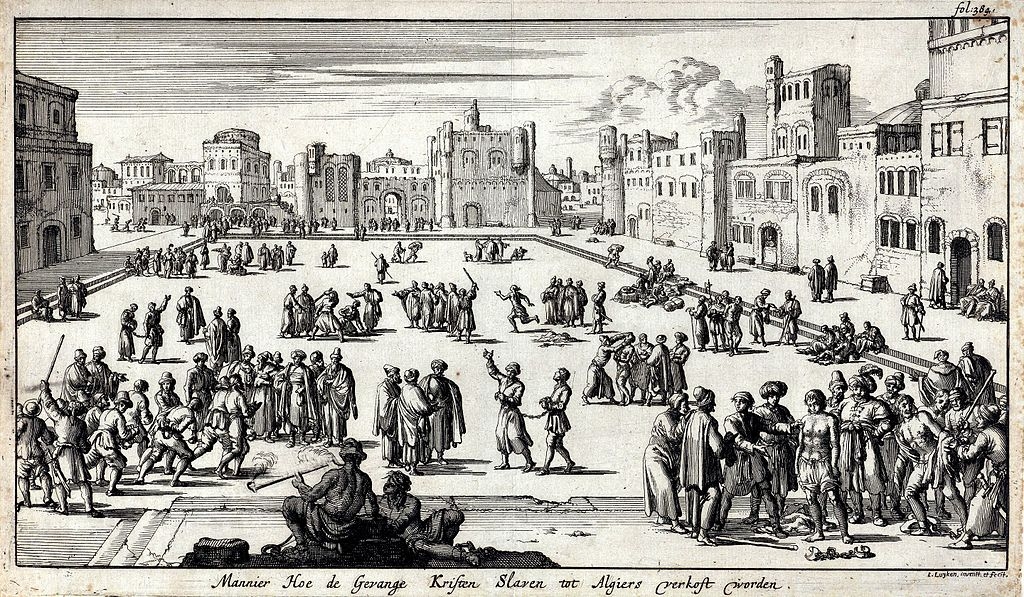
  • Slavery was a routine part of human existence from the start, and in some lands still is. Nor were black Africans the only human beings to become slaves.... In Persian and Ottoman Empires, slaves came from the Caucasus, Scandinavia, and what is now Russia. Again, no black Africans were involved.... Slavery was a common disease that affected every community on earth; a shameful secret of the whole human family.


Slavery was a routine part of human existence from the start, and in some lands still is. Nor were black Africans the only human beings to become slaves.... Slavery was a common disease that affected every community on earth; a shameful secret of the whole human family. Pictured: "The way in which Christian prisoners are sold as slaves at the Algiers market," an engraving from 1684 by Jan Luyken. (Image source: Amsterdam Historic Museum/Wikimedia Commons)

As the outrage inspired by the death of George Floyd in a botched arrest operation calms down, it may be time to consider what has been achieved by the anger it unleashed in dozens of cities across the world.

Sadly, I fear, not only that much of that anger was wasted but that it may have contributed to deeper communitarian ressentiments.

There are at least two reasons for this.

To start with Floyd's death was hijacked by merchants of grievances always on the lookout for an excuse to attack Western democracies, especially the United States. They translated Floyd into a "martyr" of American "imperialism" and pretended that the United States, along with other Western democracies, was a bastion of "racism."

Using rhetorical tricks, they dubbed Floyd's death as "murder", ignoring that the word has a precise meaning that can't be applied to the unfortunate incident in Minneapolis.

Floyd did die because a police technique used in more than 20 countries went badly wrong. But the policeman who became the agent of Floyd's death had not wished or planned to murder him. This is why English language has alternative terms such as manslaughter and premeditated murder.

The next trick used was to pretend that Floyd was killed because he was black. They ignored that the same choking technique of arrest in 2019 claimed several other lives, white and black, in the United States and France. Thus the real issue, the need for reviewing and/or dropping a technique of arrest that could lead to the death, was forgotten?

With extrapolation, the self-styled defenders of humanity saw the Minneapolis incident as an example of state-racism. However, racism is one thing and racial prejudice, even hatred, is another.

Racism denotes a world-view developed in the late 18th and early 19th centuries, dividing mankind into five races distinguished by real or imagined color of their skins. Like other monistic world-views that reduce human beings into a single element of their complex existence, racism, though deceptive in its simplicity, served as a barrier to scientific ethnography until the 20th century, preventing serious study of humanity in its rich diversity.

Other monochrome doctrines, for example Marxism with its division of mankind into classes -- proletariat good, bourgeois evil -- have a similar effect.

The racist world-view was an element in the composition of enduring state structures in all pre-modern Westphalian nations. In that regard the United States is no exception. However, it is something of an exception in being the only major nation-state to have struggled with and, as time went by, against, racism.

The War of Secession, successive civil rights movements, the fight against segregation and methods such as positive discrimination tell the story of a nation seeking to move away from racism. This does not mean that there is no racism in the US; there is, but it would be unfair to present it as a structural ingredient. By claiming that the US is a racist state, one would only encourage the white supremacists who wish that were the case.

Extrapolating further, the merchants of rage linked their claim of racism to the trans-Atlantic slave trade in a bid to cast all Western democracies as the devils incarnate.

However, slavery was a routine part of human existence from the start, and in some lands still is. Nor were black Africans the only human beings to become slaves.
According to Xenophon, some 30 percent of the population of Athens, the birthplace of Hellenic civilization, was slaves, all white men and women from the Balkans and Asia Minor.

Even earlier than that, the first states in human history -- Sumer, Akkad and Babylon -- held slaves, none of them from Africa.

The Roman Empire was a great slave-holding power. Crassus, the notorious general, was a leading slave merchant as was Julius Caesar, dealing in slaves from Western and northern Europe, today's France and Britain.

The famous revolt of slaves led by Spartacus almost exclusively involved captives from the European continent. Crassus had 10,000 of them crucified on the Appian Way.

In Russia, slavery took the form of serfdom and again, concerned almost exclusively white and Asian victims.

Slavery was also a major trade in the American continent long before Christopher Columbus ended up there by mistake. Again, none of the slaves there were from Africa, which was unknown to Incas and Aztecs.

In Asia, Khan Balugh, the seat of power in medieval China, was a major center for slave trade, as was Khiva in what is now Uzbekistan. Again, Africans were not involved in that dastardly trade in Asia that claimed countless victims for more than 1,000 years.

In Persian and Ottoman Empires, slaves came from the Caucasus, Scandinavia, and what is now Russia. Again, no black Africans were involved.

Seizing black Africans as slaves may have started under Ramses II, the Egyptian Pharaoh who needed Nubian laborers to build the Ouaji-Seboua temple.

Next, there was some exporting of black slaves by the Carthaginians to Rome after the dismantling of Hannibal's empire. Once the Romans had annexed northern Africa they used Garmant and Afri tribes of black warriors to procure slaves for the empire. Within a decade, slave-taking raids were extended beyond Tibesti and close to Lake Chad.

Thus started the history of black African involvement in capturing fellow Africans for sale as slaves.

Without the service of African tribal chiefs and rulers, no outside power would have been able to raid deep into Africa to tap endless sources of slaves.

In 652 AD, Arab General Abdallah bin Sa'id signed a trade treaty, known as "bakht", with the ruler of Darfur for the supply of 20,000 slaves a year in exchange for gold. The "bakht" remained in operation for 13 centuries.

Black African rulers and tribal chiefs were also deeply involved in the trans-Atlantic slave trade. The Sardona of Sokoto, in West Africa, made his fortune by selling slaves to Portuguese, British and French slave-traders. In his book Timbuktu School for Nomads, British author Nicholas Jubber introduces a slave trader from the Sahel who had become the richest man in the world of his time.

It is unfair to demand the removal of Colbert's status in Paris because he enacted the first slave code designed to impose legal control on the obnoxious trade and ensure some rights for the victims, and forget about African rulers who kidnapped and sold their own people.

Slavery was a common disease that affected every community on earth; a shameful secret of the whole human family.

In fact, although it lasted four centuries, black Africans of the transatlantic trade accounted for a smaller number than Europeans and Asians victims, not to mention Africans "exported" from the Horn of Africa and Zanzibar.

When it comes to slavery, we were all involved both as perpetrators and victims. Expiating that shame from our human existence is a task for us all, regardless of color and creed. Only thus the current cocktail of grievances may produce useful results.
Amir Taheri was the executive editor-in-chief of the daily Kayhan in Iran from 1972 to 1979. He has worked at or written for innumerable publications, published eleven books, and has been a columnist for Asharq Al-Awsat since 1987. He is the Chairman of Gatestone Europe.
This article was originally published by Asharq al-Awsat and is reprinted by kind permission of the author.

Well, that's what I have to say. Stephen M. Flatow

Thursday, October 10, 2019

Ocean Place Resort & Spa, nice surprise at checkout

Surprise at checkout from Ocean Place Resort & Spa

Amenity and parking charge comes out of nowhere

Imagine, if you will, you check into a first class hotel located in Long Branch, New Jersey for a 24 hour program.  You're not there to imbibe in the bar, or use the pool, or the workout room. The hotel is accommodating your late check out time because of religious observance.  And then you go to check out.

Lo and behold, there is a $30 amenity charge, basically for parking your vehicle on the premises.  A plea to the duty manager goes no where.  Logic fails.  You ask, "did you charge the folks who came last night and today, but didn't stay at the hotel?"  Of course not.  Just the folks who booked a room got waylaid by this charge.

So, basically, the room rate is not the quoted rate.  There is a hidden $30 fee that is not disclosed to you until checkout. Is the New Jersey Division of Consumer Affairs listening?

Well, that's what I have to say. Stephen M. Flatow

Thursday, March 17, 2016

From Jonathan Rosenblum at Jewish Media Resources: Trumpism and What it Says About Us

 Whoa, excellent analysis of "Trumpism."  Here's the full column (missing words and all) that appears here.   Both Republicans and Democrats will find something to complain about here.
Well, that's what I have to say. Stephen M. Flatow

Trumpism and What it Says About Us

by Jonathan Rosenblum

Yated Ne'eman March 11, 2016


Oren Cass has a point when he writes in City Journal that too much effort is being expended explaining the Trump phenomenon. After all, had the reality TV star not thrown his hat into the ring, the Republican Party would likely be well on its way to nominating "a conventional candidate like Marco Rubio or John Kasich, who would be favored to win against a Democratic Party that could not muster an option beyond a socialist punchline and a Clinton under federal investigation."

Alas, Trump is still the Republican front-runner, and we must learn what we can. In particular, the Republican Party would be well-advised to focus on the visceral anger of Trump's core supporters – middle-aged white males without college degrees – and where it comes from.

To say the least, this is not a group that is doing well or facing the future with confidence. Though causality is hard to establish, mortality rates are at least one reflection of general well-being. And white males between 45 and 54 are experiencing rising mortality rates, even as general mortality rates continue to fall. As Anne Case and Angus Deaton of Princeton have documented, since 1998 mortality rates for this group have risen by .5% per annum, after a twenty year period of annual decline of 2% per year. That contrasts, remarkably, to 1.8% decline in mortality per year over the same period for Hispanics and 2.6% for black Americans.

With manufacturing jobs declining and automation cutting into service jobs, this group is having a harder time finding and holding jobs. With traditional factory and big business employers shedding jobs, Walter Russell Mead points out, small businesses will be the primary sources of new jobs going forward. Yet government policy has made it harder, not easier, for small businesses to obtain capital.
Big banks are making ever fewer loans to small businesses, even as expensive hyper-regulation has favored the big national banks over smaller community banks, ill-equipped to deal with the expense of regulatory compliance. Small business lending by the ten largest banks declined 38% from 2006 to 2014. Only 43% of loans up to one million dollars in 2015 originated in banks, down from 58% in 2009, with the rest coming from alternative lenders who charge substantially higher rates.

Non-college educated whites (and minorities too for that matter, in all but rhetoric) have very legitimate grievances against both parties. The major parties have too frequently demonstrated their contempt and lack of concern. In 2008, candidate Obama dissed at an upscale Bay Area fundraiser poor whites taking solace for factory closings in "guns and religion." At Mitt Romney's 2012 comment about the "47% who will never vote for us" was interpreted in a similar vein.

While much of Democratic Party nomination battle has focused on income inequality, in fact the Democratic Party has long since ceased to care much about working class whites – one reason that so many Trump supporters are traditionally Democratic voters. The big Democratic donors are far more concerned with climate alarmism, and support environmental measures that are mass job cutters – e.g. blocking the Keystone Pipeline, raising energy prices by promoting non-economically viable alternatives to coal, and opposing new nuclear energy facilities. Most of the Democratic Party's signature issues, particularly social issues, have nothing to do with the economy or jobs.

TRUMPISM, IT MUST BE REMEMBERED, is something of an international movement that has affected almost every advanced democracy of late. And the reason is the same: the governments of those advanced economies have broken the most fundamental social contract with their citizens -- the commitment to treat their own citizens' well-being as taking priority over that of citizens of other nations. That is most obvious in Western Europe, which has been moving away from national sovereignty for over half a century, with power increasingly transferred from national parliaments to European Union bureaucrats in Brussels.

Mass Muslim immigration may finally be the issue that causes large number of Western Europeans – many of them drawn from the elements of European society most likely to live adjacent to Muslim "no-go zones" to which fire and police protection does not extend – to rebel. Leaders such as Germany's Angela Merkel and the bureaucrats in Brussels fairly leaped at the chance to admit millions of Muslims fleeing war-torn Syria and various other Middle Eastern hellholes as a grand humanitarian gesture, with little apparent consideration to what millions of new unassimilable immigrants would mean for either the security of the Europeans states from terrorism, or the safety of citizens, primarily woman, from ravaging bands of immigrants, or for the national culture.
As a consequence right-wing parties, some with fascist histories, are growing across the continent. Hostility to the pan-European project has risen sharply, and not only in Britain, which may soon vote to withdraw from the Common Market.

Immigration is also Trump's signature issue. Immigration, both legal and illegal, is a complicated and multi-faceted issue, and I claim no expertise. But it is one that is experienced very differently by working and middle-class voters and the political and economic elites. Reihan Salam writes, "For high-income Republicans, skilled immigrants are their colleagues, neighbors, and friends, and less-skilled immigrants provide them with low-cost child-care, restaurant meals, and other services that allow them to lead comfortable lives."

They are not worried, as is Senator Jeff Sessions (R.-Ala.), the Senate's leading immigration hawk, about immigrants driving down wages of working and middle class voters, who already cannot afford anything like the lifestyle or economic security their parents enjoyed. As Victor Davis Hanson, who spends part of each week as a farmer in California's once fertile central valley, points out, the children of the elites will not sit in classes where a quarter of the children do not speak English. And in the neighborhoods in which they live and jog, they are not likely to be attacked by pit-bulls, whose owners have little desire to speak English, much less cage, vaccinate, or license their dogs.

Mark Zuckerberg need not worry, like residents of rural Fresno County, about being sideswiped or rear-ended by those who flee the scene, leaving their wrecked cars without insurance and registration. "I don't think," observes Hanson, "Mitt Romney has had a dead pit bull, in ripe rigor mortis with a rope around its neck, dumped on his lawn, or a beautiful Queensland Heeler, torn to shreds from dog fighting, thrown into his vineyard."

BUT IF DONALD TRUMP SPEAKS to voters tired of being ignored and condescended to, he is nevertheless a disastrous representative of them. Nothing in his life until now has shown an iota of concern with those who now salute him, and he has not offered one serious policy prescription that would address their economic insecurities. All he offers is his boastful self-promotion and a call for the power to make American great again. However different in style he is to the polished and fluent Barack Obama, he offers the same promise of being some sort of miracle worker. (Remember when Obama pronounced his nomination as the day the oceans cease to rise.)

Trump is not the antidote to thought-stifling political correctness, as his supporters seem to think. Vulgarity and the lack of basic human decency are not the opposite of political correctness.
Trump's rise is but one sign this political season of something rotten in America. The Democratic Party battle between a woman with a thirty-year history of boundless greed and deceit, who could never hope to again gain a minimal security clearance unless elected president, and a septuagenarian socialist, who appears to have become no wiser since college, is, in its own way, fully as horrifying.
Both Trump and the Democrats attest to a decades' long failure of civic education in America. Unschooled Illinois farmers once stood in the sun for hours listening to Abraham Lincoln and Stephen Douglas debate: Today more Americans can identify the name Kardashian than Vice-President Biden. The Constitution and the Federalist Papers are almost unknown. President Obama, supposedly a former teacher of constitutional law, has not hesitated to resort to executive action to achieve what he cannot through Congress.

And Trump threatens to go one better. He has betrayed no understanding of the American system of checks and balances or three co-equal branches of government. Recently, he boasted that he would gut First Amendment protections of the press to make it easier for him to sue, in the manner of Turkey's Erdogan, reporters and papers that get under his tissue-thin skin.

Meanwhile college students tolerate, and even demand, limits on free speech on campus (except concerning Jews and Israel) and the absence of any semblance of due process in hearings that can have lifelong consequences. The millennials flock to the banner of Bernie Sanders, whose proposals would add trillions in new annual debt, apparently oblivious to how their own futures are blighted by already incurred government debt, which ensures they will not benefit from the social security and Medicaid for which they will soon be paying, if they are fortunate enough to find a first job. The trillions of dollars in unfunded pension obligations at the local and state level would also be news to them.

Major institutions have also failed. Trump is in part a phenomenon of wildly disproportionate free media coverage – 76% of that given to all the Republican candidates combined. That has not been just ratings driven. The mainstream media has been only too happy to advance the only Republican candidate Hillary could surely defeat.

ONE OF THE WISEST OF THE FOUNDERS, Benjamin Franklin predicted, "Only a virtuous people are capable of freedom. As nations become corrupt and vicious, they have more need of masters." And, as David French argues, "Trump is running not for president of a constitutional republic but to be the strongman of a failing state."

Trump, however, is, in Andrew McCarthy's words, "the effect, not the cause, of culture rot" – the siman not the siba in Gemara terms. In the America of my youth, the fastest way to ensure ostracism on the playground was bragging, and bragging about one's wealth would have been the worst of all. The iconic "strong" man of those days – the Marlboro Man or Gary Cooper at OK Corral – was one of few words, not a voluble ignoramus. He was never boastful and did not threaten others; he did not initiate violence or confrontation, but did not back down in its face.

One by one, many at first inclined to hold their noses and vote for Trump (and there is an argument for doing so) have determined that they cannot, for he will further lower the standards of an already debased culture. For some it was his casual dismissal of the courage of John McCain during six years of torture in North Vietnamese captivity, which left McCain permanently disabled.

For Andrew McCarthy, the lead government prosecutor in the first World Trade Center bombing, it is Trump's boast that he will order American troops to become war criminals and target the wives and children of ISIS fighters. For Stephen Hayes of the Weekly Standard, it is the impossibility of explaining to his young children why someone would mock the physical disability of a crippled reporter. For the religious conservative David French, it is his pledge to keep funding Planned Parenthood to the tune of millions of dollars, so that it can continue killing hundreds of thousands of babies a year.

These thoughtful conservatives are shocked that Trump's supporters rather than being appalled by his cruelty and malice are attracted by it. They see him as the artifact of a society from which the civic vitality catalogued by de Tocqueville has been lost and replaced by vitriol and demagoguery.
"Our Constitution was made for a moral and religious people," wrote John Adams. "It is wholy inadequate for the governance of any other." (Hat tip again to David French.) If so, America is grave danger on the evidence of this election season.